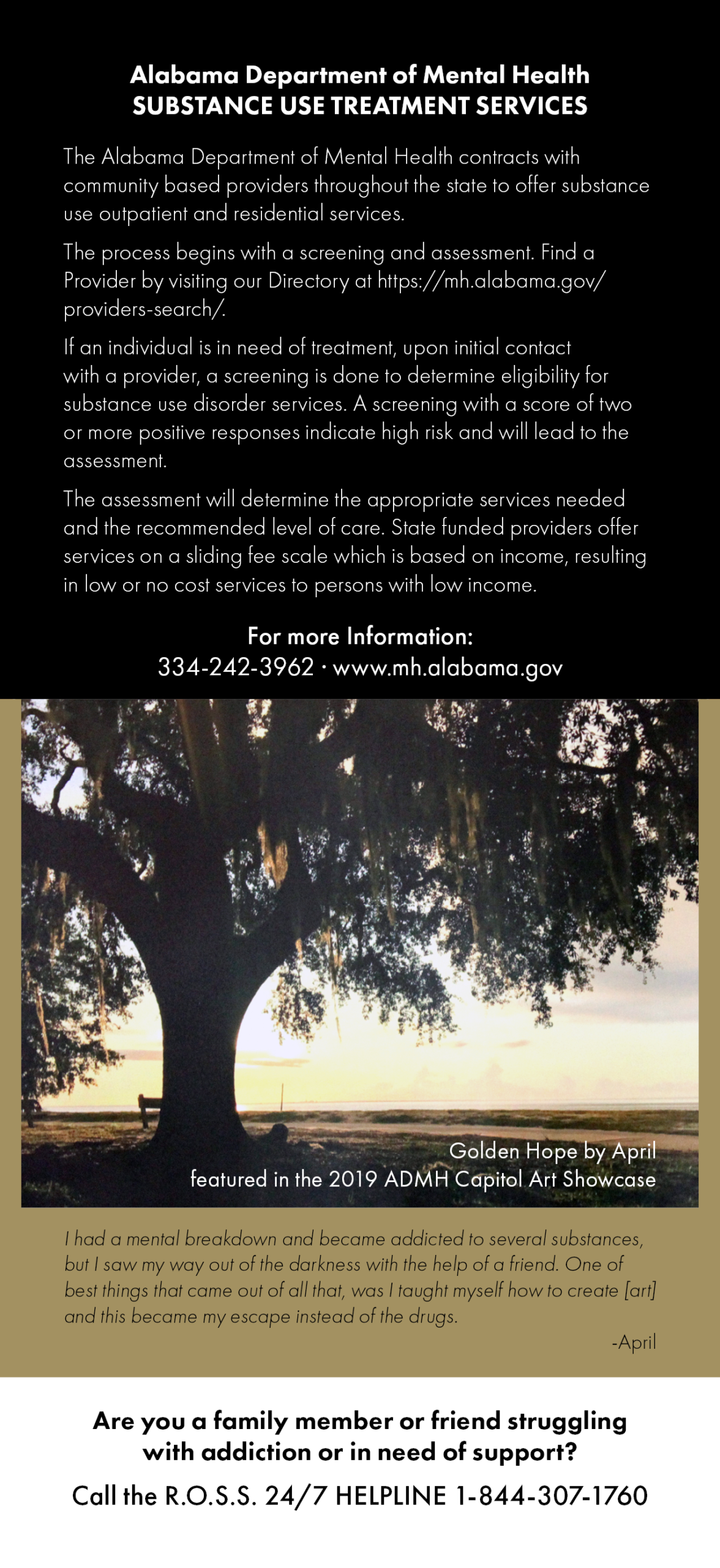
The Alabama Department of Mental Health (ADMH) is responsible for the regulation of Alabama’s public substance use services delivery system. ADMH does not operate any substance use disorder programs; however, we contract with community-based entities throughout Alabama to offer outpatient and residential services. All state-funded providers offer services on a sliding fee scale which is based on income, resulting in low or no-cost services to people with low income.
Accessing Help
If an individual is in need of treatment, upon initial contact with a provider, a screening is done to determine eligibility for substance use disorder services. A screening with a score of two or more positive responses indicates high risk and will lead to the assessment. The assessment will determine the appropriate services needed and the recommended level of care.
The screening and assessment begin the process! Find a Provider
Services Offered
Adolescent Services are available to adolescents between 13 and 18 years of age in multiple regions in Alabama. Substance use treatment agencies are equipped with qualified professionals who render age and gender appropriate evidence-based approaches that support the individual needs of each adolescent. To initiate treatment options, contact an ADMH-certified adolescent treatment provider for information on screening, assessment, and enrollment criteria. Adolescent substance use treatment services are offered by 11 certified adolescent treatment providers that span multiple counties. We want to assure opportunities for early intervention services, facilitate access to residential and/or outpatient treatment options, and provide a supportive network of recovery resources for adolescents and their families.
Adult Services are offered for those 18 and older. Alabama’s treatment providers offer withdrawal management (formerly known as detoxification), residential treatment, intensive outpatient treatment, outpatient treatment, and medication-assisted treatment. One or more of these services are offered in 59 of Alabama’s 67 counties.
Co-Occurring Treatment programs specialize in treating mental health disorders and substance use disorders concurrently, as better outcomes are achieved when patients receive simultaneous treatment for both disorders. Services are available in Calhoun, Chilton, Cullman, Dale, Jefferson, Lauderdale, Mobile, Montgomery, Morgan, and Shelby counties.
Medication-Assisted Treatment (MAT), including opioid treatment programs (OTPs), combines behavioral therapy and medications to treat substance use disorders. The medications used to treat opioid addiction include buprenorphine (Suboxone, Subutex), methadone, and naltrexone (oral medication or injectable form known as Vivitrol). There are 21 certified OTP programs in Alabama. Some OTPs offer additional medications (buprenorphine, naltrexone) in addition to methadone. A person may also receive buprenorphine from an office-based doctor who has specialized training. Naltrexone may be provided by any doctor. Services are available in Calhoun, Chilton, Colbert, Cullman, Dale, Etowah, Houston, Jackson, Jefferson, Madison, Marion, Mobile, Montgomery, Shelby, Tuscaloosa, and Walker counties.
Women’s Treatment must address the physiological responses to substance use, medical problems and disorders, pregnancy, relationships, trauma, socioeconomic issues, culture, co-occurring disorders, relevant recovery support, and continuing care. ADMH receives funding under the Federal Block Grant for pregnant and parenting females. Females eligible to enter must be pregnant; or have care and custody of dependent children or have lost custody of dependent children and have the potential for family reunification. Children can accompany mom to treatment. Pregnant women have priority admission to ALL certified treatment providers in Alabama and there are NO admission fees for pregnant women and women with dependent children.
Brooke Phillips, Director, and State Opioid Treatment Authority
334-242-3962

Related Items
ADMH SAIS WITS
Adolescent SU Treatment Flowchart
Alabama Opioid Settlement Fund Grant Program
Assessment Tools
Billing Manual
Block Grant
Consent for Dual Enrollment Prevention Check
Initiatives and Grant Projects
Medicaid Performing Provider Application
Recovery Residents Collaborative
Substance Use Disorder Service Regions
Understanding the Opioid Crisis