Public Information inquiries may be directed to 334-242-3417 or emailed to publicinformation.dmh@mh.alabama.gov.

To be added to the Press Release Distribution List, email publicinformation.dmh@mh.alabama.gov with your email.

Below you will find press releases issued by the department and news articles about ADMH or related to mental health.


MONTGOMERY, Ala. –The Alabama Department of Mental Health, community providers, and the Montgomery Biscuits will host the annual Strike Out
 HOW TO SAVE A LIFE Alabama Department of Mental Health, Alabama Opioid Overdose and Addiction Council, Community Anti-Drug Coalitions of
MONTGOMERY, Ala. - The Alabama Department of Mental Health (ADMH) in partnership with the non-profit organization, Alabama Alliance for Recovery
HUNTSVILLE, Ala. – Commissioner Kimberly Boswell, Alabama Department of Mental Health (ADMH) and Jeremy Blair, Executive Director of WellStone will
Montgomery, Ala. – National Prevention Week is celebrated May 9-15, 2021, to increase public awareness and engagements surrounding mental health
 Montgomery, Ala. - Since 2005, the Alabama Department of Mental Health has hosted the Capitol Showcase, an art show contributed
Montgomery, Ala. - Each year in May, the Alabama Department of Mental Health (ADMH) recognizes Children’s Mental Health Awareness Week
Montgomery, Ala. - Each May, the Alabama Department of Mental Health (ADMH) promotes Mental Health Month along with other national
OPIOID OVERDOSE DEATHS INCREASED IN ALABAMA IN 2020 State Agencies and Organizations Combine Efforts to Reverse the Crisis   Montgomery,

MONTGOMERY, Ala. –The Alabama Department of Mental Health, community providers, and the Montgomery Biscuits will host the annual Strike Out Stigma Night to offer essential information and resources on mental illness and substance use disorders. Join us Wednesday, August 18th for the 6:35 p.m. game!

Mental illness touches one in four people in their lifetime and starting the path to recovery is made more difficult when a person experiences prejudice caused by stigma. Stigma prevents crucial conversations, may inhibit individuals from obtaining jobs they are qualified for, and can prevent them from playing an active role in their community. Stigma is deeply hurtful and isolating and is one of the most significant barriers to treatment for mental illness and substance use disorders.

Everyone can play an important role in helping ‘Strike Out Stigma.’ Conversations and resources about mental health are vital. At the event, these community providers will offer information on services for those in need and their families:

Montgomery Mental Health AuthorityRecovery Organization of Support Specialists
NAMI AlabamaSamaritan Counseling Center
Council on Substance AbuseNew Season Metro Treatment Center
Wings Across AlabamaBradford Health Services
Mental Health America (Montgomery)Montgomery Veterans Center
Central Alabama Dept. of Veterans Affairs

Purchase tickets here for the August 18th Strike Out Stigma game. For more information, contact ADMH Public Information at publicinformation.dmh@mh.alabama.gov, 334-242-3417.

How to Save a Life

 HOW TO SAVE A LIFE

Alabama Department of Mental Health, Alabama Opioid Overdose and Addiction Council, Community Anti-Drug Coalitions of America and Walmart Host Training to Reverse an Overdose 

 MONTGOMERY, Ala. – The Alabama Department of Mental Health (ADMH) and the Alabama Opioid Overdose and Addiction Council, in partnership with the Community Anti-Drug Coalitions of America (CADCA) and Walmart will host a new training program and virtual reality demonstration on how to save a life by reversing an opioid overdose.

Over the last year, Alabama has seen an increase of drug overdoses. The state is now one of 25 with the highest increase in a 12-month period. To combat the opioid epidemic in our communities, Walmart has developed a virtual reality tool that uses Oculus headset technology to show how to save a life, that would otherwise be lost.

In addition to the training, co-chairs of the Alabama Opioid Overdose and Addiction Council, ADMH Commissioner Kimberly Boswell, State Health Officer Dr. Scott Harris and Attorney General Steve Marshall offer unique perspectives and new strategies related to the opioid epidemic. As many communities face escalating overdose rates, it has never been more important to know how to save a life.

The one-hour webinar is free, and the public is invited to join on Tuesday, July 27 at 6:30 p.m. CDT at tinyurl.com/AL-VR-Naloxone.

National Certification Achieved for Substance Use Disorder Recovery Residences in Alabama

MONTGOMERY, Ala. – The Alabama Department of Mental Health (ADMH) in partnership with the non-profit organization, Alabama Alliance for Recovery Residences (AARR) encourages safe and healthy homes as a prerequisite for recovery. AARR helps individuals with substance use disorders, offering residential settings that emphasize the development of mutual support and skills for people in recovery which enable them to lead sober, productive lives in communities.

“ADMH is committed to ensuring individuals who are seeking a life of recovery have the supports to do so,” said Nicole Walden, ADMH Director of Substance Abuse Treatment and Development. “With the establishment of AARR in the state, individuals in recovery can now trust the home they choose will provide a safe, quality environment as they move forward on their path of recovery.”

“Recovery residences provide a continuum of care for individuals looking to transform their lives,” said Curt Lindsley, President, Alabama Alliance for Recovery Residences. “For many who have completed a treatment program, returning to environments they lived in prior to treatment may be an unhealthy setting for them to be able to achieve lasting recovery going forward,” he continued.

This month, AARR was certified as an affiliate of the National Alliance of Recovery Residences (NARR). Founded in 2011, NARR supports persons in recovery from substance use disorders by improving their access to quality recovery residences through standards, support services, placement, education, research, and advocacy.

“The National Alliance for Recovery Residences is delighted to welcome the Alabama Alliance for Recovery Residences as our affiliate organization in Alabama. This achievement is a result of much hard work by the AARR team for more than a year,” said David Sheridan, Executive Director of NARR. “Our partnership means that AARR is entrusted with implementing NARR’s best practice national standards in the state, and that Alabama recovery residence providers will be able to earn nationally recognized AARR/NARR certification for meeting those standards.”

The NARR standards define the spectrum of recovery-oriented housing and services and distinguishes four residence types known as “levels of support.” The standards were developed with input from major regional and national recovery housing organizations, recovery residence providers from across the nation representing all four levels of support, and nationally recognized recovery support stakeholders.

“AARR-certified recovery residences provide home environments that foster a sense of community, accountability, and support, all while building strong supportive relationships within their local recovery communities,” continued Lindsley. With the certification and partnership with ADMH and NARR, the Alliance offers individuals the space to improve their health and wellness by living more fulfilled and self-directed lives.

Two individuals who have lived in recovery residences in Alabama and experienced successful life changes, contributed their testimonies:

  • “I’m beyond grateful for the experience I have had at the Best Life house. Not only has living there helped keep me accountable, but I have amazing like-minded women all around me. I’ve learned how to be a responsible, functioning adult while living there. I’ve learned how to create healthy friendships living there. Living at Best Life has taught me how to live a healthy life in recovery!”
  • “When I arrived at The Landing, a 12-month sober living program, I was hopeless. By the time I was 27, I had been in active addiction for over 15 years. I tried every way to get sober and I never had any luck. I spent years in and out of jail, probation, moving, only to find myself in a worse position each time. I searched for the solution everywhere and am so grateful today that I found my way to sober living. Sober living has not only saved my life, but it has also provided me the opportunity to build a new life in sobriety. I could go on about what I have been able to accomplish by applying tools I learned in sober living, but the most important thing I have gained is peace of mind. I can now choose who and what I want to be. I get to show up to life and be a productive woman with dignity. I get to rebuild relationships with family. I get to live a life of purpose. I get to help show other women, just as hopeless as I once was, that there is a better way of life. I get to live a life beyond my wildest dreams today.”

To learn more about the Alabama Alliance for Recovery Residences, visit https://aarronline.org/. To learn more about substance prevention and treatment, please visit the ADMH Division of Mental Health and Substance Abuse at https://mh.alabama.gov/division-of-mental-health-substance-abuse-services/.

HUNTSVILLE, Ala. – Commissioner Kimberly Boswell, Alabama Department of Mental Health (ADMH) and Jeremy Blair, Executive Director of WellStone will offer an exclusive look at the Alabama Crisis System of Care in action, with a presentation and a look at the new location for the WellStone Emergency Services Crisis Center.

WHEN: Thursday, July 8 at 9:30 a.m.

WHERE: 3911 Triana Boulevard, Huntsville, AL, 35805

WHO: Commissioner Kimberly Boswell, Alabama Department of Mental Health

Executive Director Jeremy Blair, WellStone

State and local officials

Community partners

PRESS: Media are invited to attend, but must RSVP to publicinformation.dmh@mh.alabama.gov, 334-242-3417 by Tuesday, July 6.


National Prevention Week 2021

Montgomery, Ala. – National Prevention Week is celebrated May 9-15, 2021, to increase public awareness and engagements surrounding mental health and/or substance use disorders. The Alabama Department of Mental Health (ADMH), Office of Prevention is proud to partner with the Substance Abuse and Mental Health Services Administration (SAMHSA) to offer learning opportunities to promote this important week.

National Prevention Week is the perfect time to invest in prevention. Community leaders and prevention specialists are standing up to prevent misuse of illegal drugs, opioids, marijuana, tobacco, alcohol, and prevent suicide and mental illness. National Prevention Week provides a chance for schools, communities, and prevention professional to re-focus on prevention efforts.

The three primary goals of National Prevention Week are to:

  • Involve communities in raising awareness about behavioral health issues and implementing prevention strategies and showcasing effectiveness of evidence-based prevention programs.
  • Foster partnerships and collaboration with federal agencies and national organizations dedicated to behavioral and public health; and
  • Promote and disseminate quality behavioral health resources and publications.

Throughout National Prevention Week, ADMH’s Office of Prevention is offering virtual opportunities to participate. The daily themes will focus on substance use and mental health disorders. In addition, important fact sheets and webinars will be shared with staff and the public.

The 2021 daily themes are:

  • Monday, May 10: Preventing Prescription Drug and Opioid Misuse (Disposal of Unused Medicines: What You Should Know)
  • Tuesday, May 11: Preventing Underage Drinking and Alcohol Misuse (Preventing Underage Drinking and Alcohol Misuse)
  • Wednesday, May 12: Preventing Illicit Drug Use and Youth Marijuana Use
  • Thursday, May 13: Preventing Youth Tobacco Use (E-Cigarettes and Vaping) (Vaping Devices (Electronic Cigarette) Drug Facts
  • Friday, May 14: Preventing Suicide (Suicide Prevention Presentation with Sharon Beeman from 11:00 a.m. – 12:00 p.m.)
    * The suicide prevention presentation will focus on suicide facts and prevention needs in Alabama. The presentation will review risk factors, warning signs, and protective factors from the Question Persuade Refer (QPR) curriculum. In addition, population shifts within the last few years removing access to lethal means will be discussed, along with how to access available resources.


We encourage young adults to participate in the #YouthLeadingPrevention Video Challenge by identifying youth leaders in programs and encouraging them to create and post videos to their social media accounts (Instagram, Facebook, Twitter, YouTube, etc.) about prevention efforts. Be sure to use the hashtag #YouthLeadingPrevention and follow these steps:

To learn more about National Prevention Week, visit the ADMH Facebook page and join the #PreventionHappensHere challenge today.


###

The Healing Quality of Art: The 16th Annual Capitol Showcase

 Montgomery, Ala. – Since 2005, the Alabama Department of Mental Health has hosted the Capitol Showcase, an art show contributed to, by individuals with mental illnesses, developmental disabilities, substance use disorders or co-occurring disorders. They graciously offer their works of art to showcase throughout the month of May, in observance of Mental Health Month.

 Life Gives Sight (2021)

The online gallery can be visited at https://mh.alabama.gov/capitol-showcase-art-exhibition-2021/  and features unique artwork and personal stories from each artist. Artwork is posted daily on ADMH social media accounts, recognizing the artists with individual posts to demonstrate their expression of mental health and life experiences. Newly added this year is online voting for Best in Show and Honorable Mention. You can vote for the artwork here.

Art benefits psychological and social recovery, especially in the areas of self-expression and discovery, relationships and social identity1. Many of the artists remark how art is encouraged and celebrated through their recovery, and the care and support they receive from community mental health centers, peers and staff.

A Zoom Reception for the artists will also be held on May 27th, 2 p.m. To learn more about the Capitol Showcase and the Alabama Department of Mental Health, please call the Office of Public Information at 334-242-3417 or email peggy.olson@mh.alabama.gov.

Due to social distancing and best practices related to COVID-19, this year’s showcase will again be online only. The need to ensure health and safety remains a priority for the artists and attendees.


About Us: The Alabama Department of Mental Health serves more than 200,000 Alabama citizens with mental illnesses, developmental disabilities, and substance use disorders. Our mission is to Serve, Empower, and Support, and promote the health and well-being of Alabamians. Visit www.mh.alabama.gov for more information.

1 Van Lith, Schofield, and Fenner. (2011). Identifying the evidence-base for art-based practices and their potential benefit for mental health recovery: A critical review.


###


CHILDREN’S MENTAL HEALTH AWARENESS WEEK

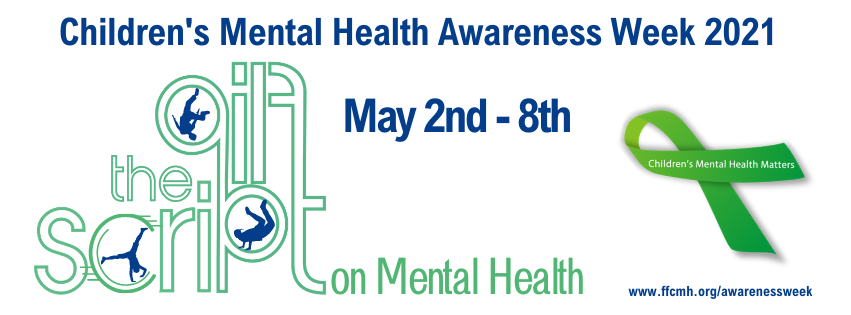
Montgomery, Ala. – Each year in May, the Alabama Department of Mental Health (ADMH) recognizes Children’s Mental Health Awareness Week (May 2nd – 8th) as an opportunity to raise awareness about the importance of children’s mental health. This year’s theme “Flipping the Script on Mental Health,” aims to put an end to prejudice and discrimination by changing hearts, minds, and attitudes regarding mental health.

Many individuals and families have been impacted by the current pandemic, which has been particularly distressing for children and youth and even more so for those previously experiencing mental health challenges. Throughout the last year, they have experienced school closures, the loss of peer interaction, social connection and time spent in-person with extended family, educators, therapists, and other community members. Many have missed important rites of passages or had to grieve the loss of loved ones or friends.

This week, and every day of the year, ADMH remains committed to inform and educate families and communities on the importance of accessing important mental health resources. Mental health stigma often discourages parents and children from seeking appropriate treatment. Children and youth with mental illnesses and their families deserve access to services and supports that are family-driven, youth-guided, and culturally appropriate.

Children’s Mental Health Awareness Week is an opportunity to change hearts, minds, and attitudes regarding mental health. We invite you to join with other communities around the state to continue the conversation about mental health and encourage positive attitudes and perceptions which are essential to a child’s healthy development.

In 2020, the Alabama Department of Mental Health served over 32,000 children with mental health prevention and treatment services. The Office of Mental Illness Community Programs and Children and Adolescent Services manages many important programs that assist children in our state, such as but not limited to, the School-Based Mental Health Collaborative and the First Episode Psychosis.

To learn more about children’s mental health and providers who offer services, including screenings, referrals, and treatment, visit https://mh.alabama.gov/children-and-adolescent-services/. 


###

MENTAL HEALTH AWARENESS MONTH: Tools to Thrive

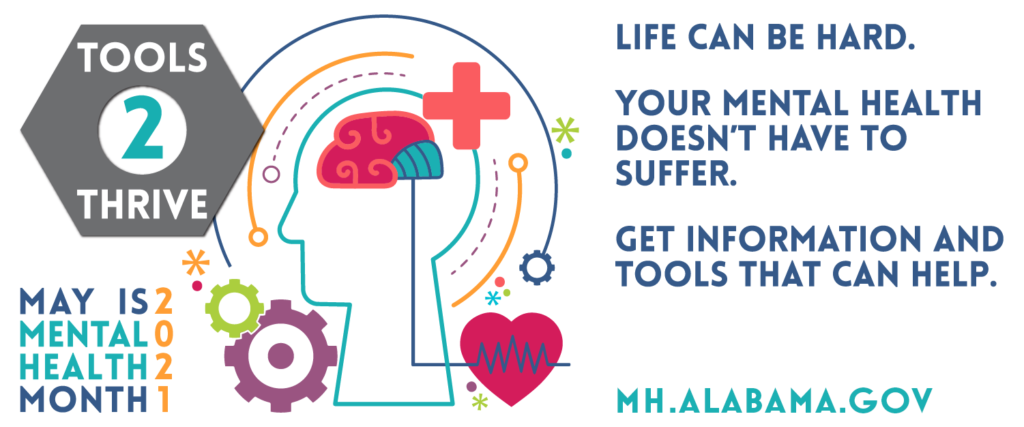
Montgomery, Ala. – Each May, the Alabama Department of Mental Health (ADMH) promotes Mental Health Month along with other national organizations to raise awareness about mental health and to reduce stigma. This year Mental Health Month’s theme is “Tools 2 Thrive” provides practical tools that individuals can use daily to prioritize mental health, build resiliency, and better cope with the challenges of COVID-19.

“I am excited to celebrate Mental Health Month. We all face challenges that can impact our mental health. This month is a perfect time to learn how to improve your mental health and increase your resiliency,” said Alabama Commissioner of Mental Health, Kimberly Boswell.

It is critical to have tools to support ourselves and others, when faced with challenges. We encourage individuals to explore the Mental Health America toolkit which provides important tips and information called Tools2Thrive: Adapting After Trauma and Stress, Processing Big Changes, Getting Out of Thinking Traps, Radical Acceptance, Taking Time for Yourself, and Dealing with Anger and Frustration.

The COVID-19 pandemic has had a profound impact on the mental health of people of all ages. Now, more than ever, focus on improving our mental health like we focus on our physical health. Mental health is essential to everyone’s overall health and wellbeing. One way to check in with yourself is to take a screening at www.mhascreening.org. It is a quick, free, and private way for someone to assess their mental health and recognize signs of mental problems. With effective treatment, all individuals with mental illness, even serious mental illness, can make progress toward recovery and lead full productive lives.

We invite mental health providers and partners, and business, civic and faith-based communities to join in spreading the word that mental health is something everyone should care and talk about, share the toolkit and conduct awareness activities in their local communities.

For more information on Mental Health Awareness Month, please contact the Office of Public Information at publicinformation.dmh@mh.alabama.gov or 334-242-3417.


###

OPIOID OVERDOSE DEATHS INCREASED IN ALABAMA IN 2020
State Agencies and Organizations Combine Efforts to Reverse the Crisis


Montgomery, Ala. – The Alabama Opioid Overdose and Addiction Council is raising awareness about the increased number of opioid overdose deaths in 2020. Opioids are drugs such as heroin, fentanyl and prescription medications like hydrocodone and oxycodone. The Centers for Disease Control and Prevention (CDC) issued an official Health Advisory on December 17, 2020, alerting healthcare professionals of a “substantial increase in drug overdose deaths across the United States, primarily driven by rapid increases in overdose deaths involving synthetic opioids, excluding methadone, likely illicitly manufactured fentanyl.”  Illicitly manufactured fentanyl is now known to be present in all street drugs, including heroin, cocaine, methamphetamine and counterfeit prescription pills.

According to the CDC, there were 81,230 drug overdose deaths in the United States in the 12 months ending May 2020, the largest number ever recorded for a 12-month period. During that period, drug overdoses increased more than 20% in Alabama, resulting in the state being one of 25 with the highest increase.

The Alabama Department of Public Health (ADPH) supports the collaborative efforts of the Governor’s Alabama Opioid Overdose and Addiction Council to develop effective strategies to reverse the opioid crisis in our state. State Health Officer Dr. Scott Harris said, “The crisis of opioid use and addiction reaches all strata of society in significant ways, and the COVID-19 pandemic has created additional challenges. We encourage the friends and families of people with substance use disorders to educate themselves about the lifesaving use of naloxone and to support their loves ones in seeking and receiving care without judgment or blame.”

The ongoing anti-stigma campaign, Stop Judging, Start Healing, initially focused on the public but is now being extended to provide education to healthcare providers. The ADPH Pharmacy Division is responsible for the Alabama Prescription Drug Monitoring Program (PDMP) which includes maintaining the database of dispensed schedule II through V controlled substances in Alabama. Recent improvements to the PDMP make it easier for prescribers to identify those misusing opioids and to motivate those with an opioid abuse disorder to find help for themselves, their families and communities. The number of prescribers accessing PDMP data increased in 2020, which indicates prescribers are increasingly aware of opioid misuse. The council is committed to responding to this acute need to decrease misuse and overdoses in Alabama and raising awareness of the resources that are available to help those with substance use disorders.

In partnership with the Alabama Department of Public Health and the Alabama Department of Mental Health (ADMH), the Jefferson County Department of Health (JCDH) developed an online training platform for individuals around the state to receive naloxone training and receive a free naloxone kit by mail. Naloxone is a life-saving medication that can reverse an opioid overdose.  It is available as an easily administered nasal spray (also known as Narcan®) or injection. The training takes less than 15 minutes.

Individuals may access the training on the JCDH website at www.jcdh.org and search naloxone or Narcan®. Friends and family members of individuals using the substances mentioned above should be educated on the use of naloxone and have naloxone available. If you have questions about receiving a free Narcan® kit through JCDH, please email naloxonetraining@jcdh.org or call 205-930-1065.

“The Alabama Department of Mental Health fully encourages the training and use of Naloxone to decrease overdose deaths of our loved ones. Too many friends and family members are lost to opioid use disorder. We can help them begin the journey of recovery by educating ourselves about Naloxone,” said Commissioner Kim Boswell, ADMH and Co-chair of the Alabama Opioid Overdose and Addiction Council.

“The opioid crisis has caused tremendous suffering for its victims in Alabama, which has intensified with the unprecedented challenges of this past year,” said Attorney General Steve Marshall. “More than ever, it is important that we face this problem effectively, focusing not on shame and stigma, but on prevention, treatment and healing. We need to make people aware of the dangers, because knowledge brings power, and we need to provide tools that will save lives. That is why we want people with vulnerable loved ones to know how to get naloxone and use it in cases of overdose. If you or someone you know is struggling with opioids, please find out what assistance is available and ask for help.”

Help is available for those struggling with substance use through a free 24/7 substance use helpline at 1-844-307-1760. This is a statewide service sponsored by the Alabama Department of Mental Health and staffed by peer recovery support specialists from the Recovery Organization of Support Specialists (ROSS) to help individuals navigate treatment and recovery systems.

###