Public Information inquiries may be directed to 334-242-3417 or emailed to publicinformation.dmh@mh.alabama.gov.

To be added to the Press Release Distribution List, email publicinformation.dmh@mh.alabama.gov with your email.

Below you will find press releases issued by the department and news articles about ADMH or related to mental health.


988: SUICIDE AWARENESS AND SUPPORT AT THE HOLIDAYS Montgomery, Ala. – This holiday season, the Alabama Department of Mental Health,
NATIONAL RECOVERY MONTH 2023 Every Person. Every Family. Every Community.   Montgomery, Ala. – September is National Recovery Month and
ADMH heart logo
SUICIDE PREVENTION AWARENESS MONTH Resources for Everyone Montgomery, Ala. – Every one of us has a role to play in preventing
ADMH hosts the 36th Annual National Prevention Network Conference Birmingham, Ala. – The Alabama Department of Mental Health is the
ADMH heart logo
SAVING LIVES ACROSS ALABAMA The One Year Anniversary of 988 Montgomery, Ala. – After just one year in operation, the
ADMH heart logo
IMPROVING MENTAL HEALTH OUTCOMES FOR CHILDREN AGE BIRTH TO 12 AND THEIR FAMILIES A New Grant Creates the Opportunity for
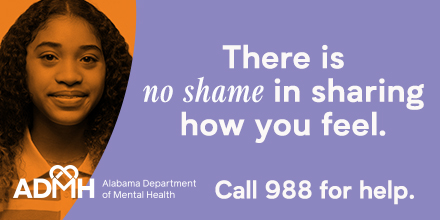
There is no shame in sharing how you feel. Call 988 for help.
NO SHAME Sharing Hearts and Minds to Prevent Suicide Montgomery, Ala. - The Alabama Department of Mental Health introduces the
Strike Out Stigma logo
MONTGOMERY, Ala. – Every year, millions of people in the United States are impacted by mental illness. Living with a
MENTAL HEALTH AWARENESS MONTH 2023 Look Around, Look Within Montgomery, Ala. - Each May, the Alabama Department of Mental Health
988: Suicide Awareness and Support at the Holidays

988: SUICIDE AWARENESS AND SUPPORT AT THE HOLIDAYS

Montgomery, Ala. – This holiday season, the Alabama Department of Mental Health, and our partners across the state would like to share a message of hope if you or someone you love is experiencing feelings of despair or grief or is in a suicidal crisis. It can be hard for many during this time. The holidays may be stressful and overwhelming, but there are resources available online and by dialing 988, which is available 24/7, with a trained crisis counselor on the other end of the line.

According to the Centers for Disease Control and Prevention (CDC), 49,449 individuals died by suicide in the year 2022. This was the highest number ever recorded in the United State. We must continue to connect, communicate, and work together to decrease suicide and increase mental health wellness for ourselves and our loved ones. Reaching out, talking to peers, family, or a mental health professional can help ease some depression, stress and anxiety that come with the holiday season, or any day of the year.

While you or someone you know may be feeling lonely, afraid, anxious, lost, or overwhelmed, you are not alone. While these emotions can be uncomfortable and unpleasant, they are normal, and there is no shame in feeling this way.

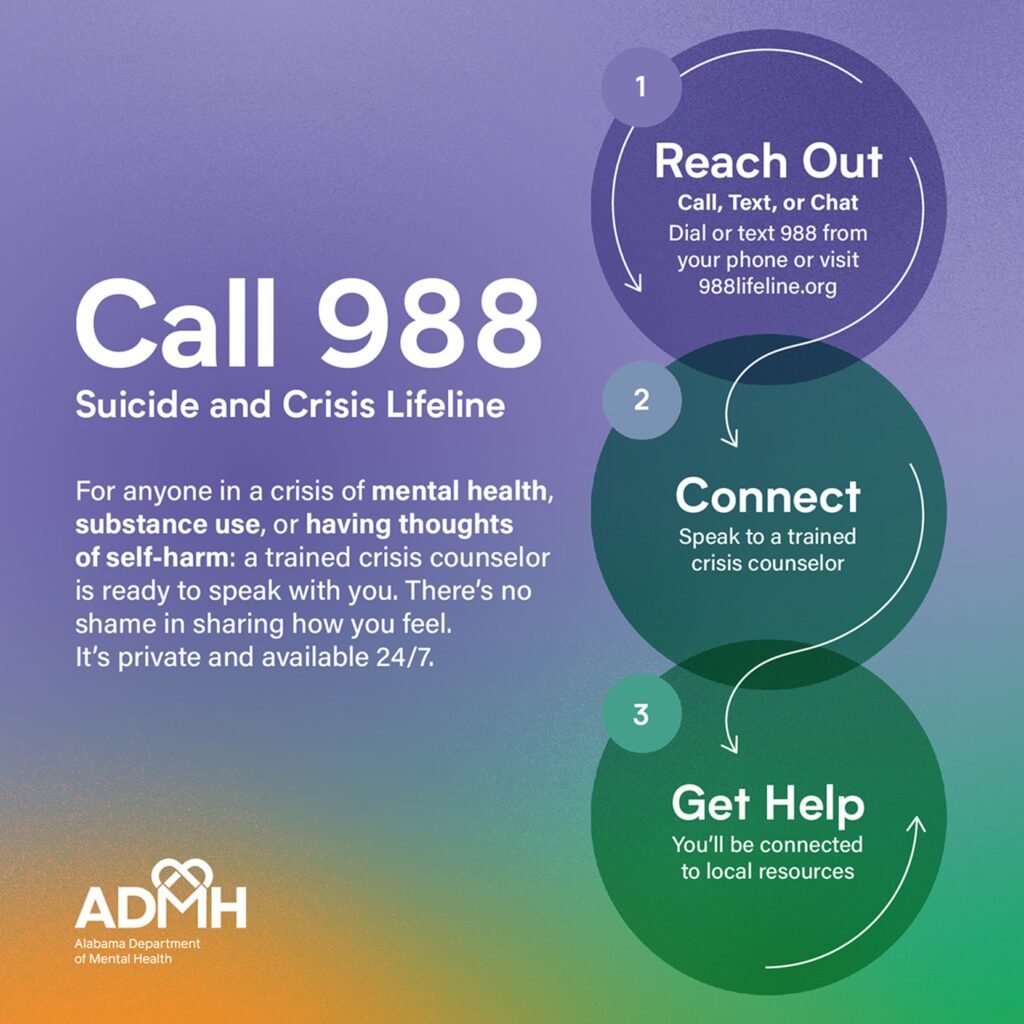
The Alabama Department of Mental Health encourages the continuance of the “No Shame” Suicide Prevention campaign, which strives to decrease the stigma associated with suicide and mental illness and promotes the 988 Suicide and Crisis Lifeline. 988 is for anyone experiencing a mental health crisis, substance use, or thoughts of suicide. A qualified and trained crisis counselor is ready to assist you. It is private and is accessible 24/7. In a crisis, dial 988.

For more information about crisis care in Alabama, visit https://mh.alabama.gov/crisis-centers/ and for mental health providers in your area, visit https://mh.alabama.gov/providers-search/.  Learn more about Suicide Prevention partners in Alabama at https://sprc.org/state/alabama/ and https://afsp.org/chapter/alabama.


For information on 988 and the campaign to share this vital information across Alabama, call the ADMH Office of Public Information, publicinformation.dmh@mh.alabama.gov or 334-242-3417.

###

National Recovery Month 2023

NATIONAL RECOVERY MONTH 2023

Every Person. Every Family. Every Community.


Montgomery, Ala. – September is National Recovery Month and the Alabama Department of Mental Health (ADMH), the Division of Mental Health and Substance Use Treatment Services, and our community partners raise awareness and educate individuals and families through information and events to show the importance of substance use treatment, substance disorders, and recovery, as well as to promote and support new evidence-based treatment and recovery practices.

ADMH values all individuals within Alabama’s recovery community and strives to increase knowledge, compassion, and connections that cultivates recovery and resilience. Through Recovery Month, individuals can become more aware and able to recognize the signs of substance use disorders and encourages people in need of recovery services to seek help.

National Recovery Month reminds us that Recovery is for Everyone: Every Person. Every Family. Every Community. Through reducing barriers and creating an inclusive space, we can decrease the stigma associated with individuals receiving treatment for substance use disorders or mental health conditions.

ADMH recognizes the dedicated and committed professionals and service providers who provide prevention, treatment, and support services. Finding a local provider is simple and easy through the ADMH Directory of Providers. Also, find support with substance use recovery partners such as The Recovery Organization of Support Specialists (R.O.S.S.) and People Engaged in Recovery (P.E.I.R.).

Everyone’s recovery process is distinct and unique. Utilizing a reversal medication, such as naloxone, can facilitate the transition to a path of recovery. To assist in this endeavor, the Jefferson County Department of Health and ADMH have collaborated to provide free kits and training on the use of naloxone to the public, first responders, and law enforcement. Get the lifesaving, free training here.

ADMH is also a partner in the “Odds Are” campaign in partnership with VitAL Alabama to address the fentanyl epidemic through education, real-life stories, and information on the availability of free opioid overdose reversal medications.

Through a collaboration with the Alabama Department of Public Health and VitAL Alabama, ADMH provides Connect Alabama, an app that is a behavioral health services and treatment finder application that provides individuals with instant access to education, information, and services related to substance use, mental health, and prevention. The app is available for download on iOS through the app store and for Android devices via Google play.

Please join ADMH and our community partners as we advocate and celebrate the gains made by those in recovery.

###

Suicide Prevention Awareness Month 2023

SUICIDE PREVENTION AWARENESS MONTH

Resources for Everyone

Montgomery, Ala. – Every one of us has a role to play in preventing suicide. September is National Suicide Prevention Month, a time to raise awareness about suicide. The Alabama Department of Mental Health (ADMH), its community partners, and other mental health organizations collaborate each year to provide hope, encouragement, and vital information to individuals and families affected by suicide.

Suicidal thoughts can arise in anyone, regardless of age, gender, or social condition. According to the Centers for Disease Control and Prevention (CDC), suicide is the 10th leading cause of death among all ages in the U.S. and the second most common cause of death among young adults ages 10-34. Alabama had 821 reported suicides in 2021.

Help is available, and you are not alone in your emotional distress. For free confidential support 24/7, call or text 988 to be connected to a trained counselor. There are four 988 call centers now located in Alabama. Learn more here.

Additionally, to promote and educate about suicide prevention, ADMH developed the “No Shame” suicide prevention campaign, which addresses the stigma associated with suicide and mental illness. Suicide is preventable, and we can help minimize suicide in our communities and society by recognizing the warning signs, discussing our thoughts, encouraging prevention and resilience, eliminating stigma, and committing to social change.

As a part of the Alabama Crisis System of Care, Crisis Centers are tailored to the specific needs of each community they serve. Crisis services are available to meet the needs of individuals, including emotional distress and suicide. There are currently four crisis centers: WellStone (Huntsville, Alabama); AltaPointe Health (Mobile, Alabama); Carastar (Montgomery, Alabama); and JBS Craig Crisis Center (Birmingham, Alabama). Two additional crisis centers are scheduled to open later in the year, SpectraCare (Dothan, Alabama); Indian Rivers (Tuscaloosa, Alabama).

Suicide rates among veterans are particularly high. Compared to Americans who have never served in the armed forces, veterans are at 1.5 times the risk of dying by suicide. Female veterans are at an even higher risk, with a risk factor of 2.2 times higher than male veterans. In 2021 alone, 143 Alabama veterans died by suicide.

The Alabama Department of Veterans Affairs (ADVA) provides resources and services in collaboration with ADMH to Veterans in Crisis.  As a part of its outreach efforts, “Operation We Remember” honors and remembers the veterans in Alabama who lost their lives to suicide, and “Alabama’s Challenge: Veteran Suicide Prevention” is long-term effort to reduce the stigma associated with mental illnesses across the state. It also promotes suicide prevention and awareness through monthly town hall sessions for veterans and their families. Veterans for Hope provides support for veterans, friends, and family members by offering mental health resources and warning signs to help identify a Veteran in crisis. If you’re a veteran or service member and in crisis, please press 1 after calling 988 or call the Veterans Crisis Line for help.

During Suicide Prevention Month, please join the Alabama Department of Mental Health and our community partners in spreading hope and encouraging prevention.

###

ADMH hosts the 36th Annual National Prevention Network Conference

ADMH hosts the 36th Annual National Prevention Network Conference

Birmingham, Ala. – The Alabama Department of Mental Health is the host agency for 36th annual National Association of State Alcohol and Drug Abuse Directors (NASADAD) National Prevention Network Conference (NPN), August 15-17, with an Opening Session on August 15 at the Birmingham-Jefferson Convention Center (BJCC).

The National Prevention Network (NPN) Conference has a long history with the first conference held in 1988. Over the years, the conference has grown to now hosting 700-1,000 participants. ADMH is proud the NPN Conference is being held in Alabama for the first time. ADMH will also present several conference sessions.

WHEN: Tuesday, August 15, 2023, at 8:30 a.m.

WHO: Alabama House of Representatives, District 21 –Rex Reynolds
ADMH Commissioner Kimberly Boswell
Mayor of Birmingham Randall Woodfin
Executive Director of National Association of State Alcohol and Drug Abuse Directors, Rob Morrison

WHERE: Birmingham-Jefferson Convention Center (BJCC)
2100 Richard Arrington Blvd. North
Birmingham, AL 35203

Media are invited. Please RSVP to Malissa Valdes at malissa.valdes@mh.alabama.gov before Monday, August 14, 3 p.m.

Saving Lives Across Alabama – The One Year Anniversary of 988

SAVING LIVES ACROSS ALABAMA

The One Year Anniversary of 988

Montgomery, Ala. – After just one year in operation, the National Suicide and Crisis Lifeline in Alabama has received more than 45,000 contacts, including more than 30,000 calls; 6,000 chats; and 8,000 texts. These are not just numbers. They are real people in our state who called, sent chats or texts, seeking immediate help in a crisis, and received real-time life-saving counseling from mental health professionals.

Since July 16, 2022, 988 has served as “the new 911” for mental health crisis services in Alabama. This year commemorates its one-year anniversary. This life-saving service and Crisis Centers are part of Alabama’s Crisis System of Care, launched by Governor Kay Ivey and the Alabama Department of Mental Health with strong support from the Legislature. The Alabama Crisis System of Care is a continuum of public mental health crisis services that are positively transforming our state’s crisis response.

“Every Alabamian deserves 24/7 access to public mental health care. 988 expands this vital access and serves as an entry point into Alabama’s Crisis System of Care, particularly for individuals that need someone to call, someone to respond, and somewhere to go,” said Commissioner Kimberly Boswell, Alabama Department of Mental Health.

Over the past year, 988 connected people directly to critical crisis services. While Alabama response rates continue to improve, call volume month to month has grown, demonstrating the crucial need for this service.

Calls are answered right here in the state. These centers are located in Mobile at AltaPointe Health in Mobile; in Birmingham at the JBS Craig Crisis Center and The Crisis Center Birmingham; and in Huntsville at WellStone. Carastar Health in Montgomery and SpectraCare Health in Dothan will begin operations by the end of 2023.

988 Testimonial

WellStone’s Call Center 988 staff received a call from a 19-year-old woman, assumed to be intoxicated and in distress. She stated she thought about harming herself that day. She disclosed that she often felt depressed and drank alcohol when she felt that way. She said she didn’t want to continue in the cycle of drinking. WellStone’s 988 Call Center Staff talked with her about how drinking can increase suicidal thoughts and options for substance use treatment. The staff discussed a crisis management plan to manage depression without alcohol and offered resources at a local provider. The caller left the conversation with practical next steps for recovery.

988 is a lifeline for individuals experiencing a mental health crisis, particularly those in rural communities, and provides real-time, immediate connections and assistance to individuals in crisis and their loved ones. When you call, chat, or text 988, you are connected with a mental health professional who can talk to you, offer crisis resources that may come to you, or immediately direct an individual to their closest Crisis Centers for help.

988 Testimonial

AltaPointe Health’s 988 Call Center staff’s first active suicide attempt call, was from a female client in Mobile who had attempted suicide, stating she taken an overdose of prescription medication. She did not want AltaPointe to call 911 and hung up on the 988 Call Center staff when family entered her home. The Call Center staff called 911, and first responders were able to locate and take her to an acute care ER. A day later, the client called AltaPointe Access to Care Line and was admitted to AltaPointe’s EastPointe Hospital in Daphne for treatment.

988 saves lives. Access to care saves lives. A statewide Crisis System of Care ensures every Alabamian has someone to call, someone to respond, and somewhere to go during a mental health, substance use, or suicidal crisis. Visit www.mh.alabama.gov for more information about 988, Crisis Centers, and the Alabama Crisis System of Care.

###

Improving Mental Health Outcomes for Children Age Birth to 12 and Their Families

IMPROVING MENTAL HEALTH OUTCOMES FOR CHILDREN AGE BIRTH TO 12 AND THEIR FAMILIES
A New Grant Creates the Opportunity for a Team-Based Approach

 Montgomery, Ala. – The Alabama Department of Mental Health (ADMH) has received a five-year grant from the Substance Abuse and Mental Health Services Administration (SAMHSA) for Promoting Positive Early Experiences and Relationships in Alabama: A Team-Based Approach (PPEER). Through a partnership between ADMH and the Alabama Department of Early Childhood Education (ADECE), PPEER will create a cohesive and sustainable infrastructure that results in improved mental health outcomes for children birth-12 years and their families who are at risk of being or are already in protective custody with the Alabama Department of Human Services (ADHR).

PPEER will include a full continuum of promotion, prevention, and intervention through comprehensive wraparound services that are evidence-based and trauma-informed. These services will be provided by a Children’s Mental Health Team (CMHT) working with county ADHR staff and family court teams, in a coordinated effort to prevent child maltreatment and neglect; reduce the chances of the child being diagnosed with a mental illness, including severe emotional disturbance; and to help to keep families together. The project will initially occur in three pilot counties: Jackson, Jefferson, and Mobile; and expand to other counties in years three to five.

The Children’s Mental Health Team (CMHT) will include an Infant and Early Childhood Mental Health (IECMH) Consultant and at least one mental health clinician trained in IECMH. For school-aged children, a school mental health service coordinator and a school-based mental health therapist will also serve on the team. The CMHT will coordinate integrated services leading to positive outcomes for infants, young children, and their families to alleviate, remediate, and decrease mental health challenges that may interfere with healthy childhood development and parent/caregiving relationships.

For more information on the grant and initiative, please contact the Office of Infant and Early Childhood Special Programs.

No Shame – Sharing Hearts and Minds to Prevent Suicide

NO SHAME
Sharing Hearts and Minds to Prevent Suicide

Montgomery, Ala. – The Alabama Department of Mental Health introduces the “No Shame” Suicide Prevention campaign, addressing the stigma surrounding suicide and mental illness. The campaign speaks not about judgment but rather of hope. The campaign also features the National Suicide and Crisis Lifeline number, 988. If you or someone else is in crisis, you can immediately call, chat or text a mental health professional by contacting 988. Since July 16, 2022, more than 37,700 Alabamians have contacted 988.

In 2021, 821 individuals died by suicide in Alabama, according to the Alabama Department of Public Health. More than 15 percent were children or adolescents between the ages 10-19. An individual may experience suicidal thoughts or feelings due to many factors. These may cause someone to feel hopeless and/or believe that it is impossible to change the situation. Sharing our feelings can be hard. Friends, family, and mental health professionals are here to help, and you can share, without fear. Speaking freely with others, including peers and counselors can help. They can offer important resources. There is a strong support system of people ready to listen and help.

Click here to watch a video from the No Shame Campaign. Learn the warning signs of someone in a mental health crisis, and how to reach out for help, for yourself or a loved one.

There is no shame in sharing. If you are in crisis, call 988. For crisis care information in Alabama, visit https://mh.alabama.gov/crisis-centers/. For mental health providers in your area, visit https://mh.alabama.gov/providers-search/. Learn more about Suicide Prevention partners in Alabama at https://sprc.org/state/alabama/ and https://afsp.org/chapter/alabama.

Strike Out Stigma Baseball Night – Ending the Stigma

MONTGOMERY, Ala. – Every year, millions of people in the United States are impacted by mental illness. Living with a mental illness can make it difficult to find a balance in daily life and maintain recovery; and stigma can exacerbate symptoms and lower the probability of seeking therapy.

To offer mental health resources and share new information and locations, the Alabama Department of Mental Health, community providers, and the Montgomery Biscuits will host the annual Strike Out Stigma Night on Friday, May 5th  at 6:35 p.m. At the Strike Out Stigma game, discover more about mental health help in your community, while increasing your awareness about acceptance, and recovery.

Strike Out Stigma Providers and Partners:

  • Alabama Department of Veteran Affairs
  • Carastar Health
  • Alabama Council on Developmental Disabilities
  • NAMI Alabama
  • Wings Across Alabama
  • Council on Substance Abuse
  • Recovery Organization of Support Specialists (ROSS)
  • Mental Health America – Montgomery
  • Bradford Health Services
  • Montgomery Vet Center

Purchase tickets here for the May 5th Strike Out Stigma game. For more information, contact ADMH Public Information at publicinformation.dmh@mh.alabama.gov, 334-242-3417.

MENTAL HEALTH AWARENESS MONTH 2023

Look Around, Look Within

Montgomery, Ala. – Each May, the Alabama Department of Mental Health (ADMH) promotes Mental Health Awareness Month along with other national organizations to raise awareness and acceptance surrounding mental health and to reduce stigma. This year Mental Health Month’s theme is “Look Around, Look Within” encourages individuals to look around and look within. From your neighborhood to friends and families, many factors come into play when it comes to mental health.

“This year’s Mental Health Awareness Month is the perfect  opportunity to inform Alabamians of life saving resources, like 988 and Crisis Centers, for individuals with mental illness, substance use disorders who may be in a  crisis.  Whether we share resources, encourage others to seek help, or simply are there for someone when they reach out to us, we instill hope and reduce stigma” said Alabama Commissioner of Mental Health, Kimberly Boswell.

In a crisis, call 988, an easy to remember number, offering a direct connection to compassionate, accessible care and support for anyone experiencing mental health-related distress. Anyone can dial 988 if they are worried about a loved one who may need crisis support.

An individual’s decision  to access care, can impact if, how, and when mental health needs are met, which in turn affects mental health. However, one can take steps to protect their well-being. One of the steps you can take is reach out and make a call to a Warmline such as the Wings Across Alabama’s Warmline or the R.O.S.S Helpline, both of which are available 24/7, with peer support specialist available to offer assistance or resources.

If crisis stabilization is needed, Crisis centers are designated places for individuals to walk in, or for law enforcement, first responders, and EMS personnel to take an individual that is in mental health or substance abuse crisis. At the center, the individual may receive stabilization, evaluation, and psychiatric services. Click here for the locations of Crisis Centers.

We invite mental health providers and partners, and business, civic and faith-based communities to join in sharing the vital information that mental health is something everyone should care and talk about, download the toolkit and engage in awareness activities in their communities.

For more information on Mental Health Awareness Month, please contact the Office of Public Information at publicinformation.dmh@mh.alabama.gov or 334-242-3417.

###